

What Modern Cannabis Cultivators Can Learn from Caribbean Growing Traditions
There’s a tendency in modern cultivation to equate progress with control: better systems, tighter environments. More inputs, more data, more precision. While those tools have undeniably pushed cultivation forward, they’ve also created a kind of distance between growers and the plants themselves.
In the Caribbean, cultivation has developed under very different conditions. Limited inputs, shifting weather, varied terrain. Here, the environment isn’t something to be engineered: it’s something to be understood. And over generations, farmers have refined an approach that is less about control, and more about relationships.

Ganja planted in pure volcanic ash in Saint Vincent.
For modern breeders, there’s a lot to learn in that shift.
Less input, more awareness
One of the first things you notice is how little is added. Fertility is often built from what’s already available. Soil is reused, amended organically, and allowed to develop over time rather than reset between cycles. Feeding isn’t a rigid schedule, but a response. Plants are given what they need when they show they need it.
There’s a patience to this approach that can feel unfamiliar if you’re used to dialing in every variable. But it leads to something important: plants that are not dependent on constant intervention.
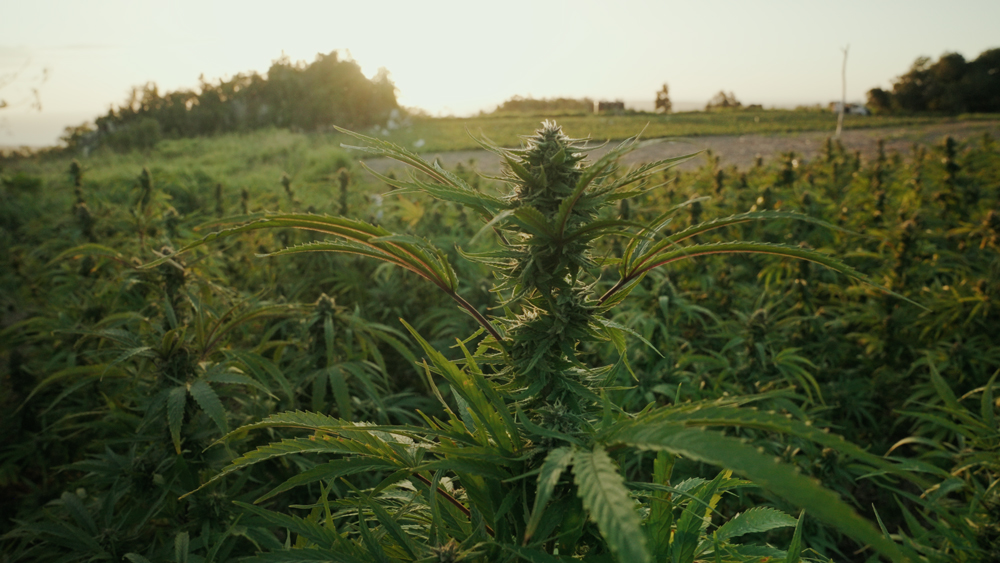
Saint Vincent cannabis grow.
For home growers, this means softening your grip on your system. Instead of reacting immediately to every fluctuation, give the plant time to respond. Watch how it adjusts over a few days. Pay attention to posture, color, and vigor. Often, the plant is already working toward balance.
Learning to read those signals is a skill, and like any skill, it develops over time.
Working with the environment, not against it
There’s also a different relationship to the environment. In controlled settings, the goal is consistency. Temperature, humidity, and light cycles are calibrated to minimize variation. In the Caribbean, variation is the baseline.
Humidity rises and falls. Rain comes unexpectedly. Wind moves through fields without warning. Rather than trying to eliminate these variables, growers work within them. Over time, this creates plants that are deeply adapted to their surroundings.
This is where the concept of terroir becomes tangible. The same genetic line grown in different parts of the Caribbean can exhibit different traits depending on altitude, soil composition, and proximity to the coast.
Saint Vincent outdoor grow near the coast.
For growers outside of those regions, there’s still something to take from this. Every grow space has its own microclimate, even indoors. Airflow patterns, temperature swings, and light intensity gradients. Instead of treating your space as uniform, start noticing its variations.
Where does heat build up? Where does moisture linger? Which plants seem to thrive in certain corners?
Working with those differences, rather than flattening them, can lead to more dynamic and resilient outcomes.
According to Humboldt Seed Company Chief Science Officer Benjamin Lind, one of the biggest lessons he took away from connecting with growers throughout the Caribbean wasn’t a specific cultivation technique, but a mindset.
“It’s all about resourcefulness,” Lind said. “Do what you can with what you’ve got and where you are.
Saint Vincent-style nursery with bedsheets and sticks forming a dome to protect germinating cannabis seeds and seedlings from being eat by birds.
That kind of resourcefulness runs through many traditional growing communities. Instead of just chasing the newest equipment on YouTube or trying to recreate someone else’s setup from across the world, growers tend to perform best once they learn to understand their specific conditions and thoughtful decisions within their constraints at the forefront.
For modern breeders and home growers alike, it’s a reminder that great cultivation doesn’t always come from having the perfect environment. More often, it comes from learning how to work intelligently with the one that’s already in front of you.
The role of natural stress
Another lesson, often overlooked, is the role of natural stress.
In highly controlled environments, stress is often avoided. Nutrient levels are stabilized, watering is consistent, and external pressures are minimized. In the field, stress is part of the equation.
Wind strengthens the structure. Inconsistent watering encourages deeper root development. Fluctuating conditions push plants to adapt in real time. This doesn’t mean stress should be introduced carelessly, but it does challenge the idea that perfect conditions always produce the most interesting results.
Jamaican researcher Dr. Machel Emanuel examining the fruits of his labor.
In many cases, some of the most complex terpene expressions emerge from plants that have had to respond to their environment, not just exist within it.
For the home grower, this might mean allowing for slight drybacks between waterings or exposing plants to natural airflow rather than completely isolating them. Small adjustments that encourage resilience without compromising health.
A different sense of time
Underlying all of this is a different pace. Caribbean growing traditions aren’t built around maximizing output in the shortest possible time. They’re built around continuity. Season after season, plants are selected, observed, and refined in the same environments. Knowledge accumulates slowly, but it holds.
Local grower holding Lamb’s Bread cannabis strain.
For breeders and growers, this is a reminder that not everything can (or should) be accelerated.
Understanding a genetic line, especially one tied to a specific region, takes more than a single cycle. It requires repetition, observation, and a willingness to let the plant reveal itself over time.
What emerges from all of this is a shift in perspective: less intervention, more observation. Less control, more alignment. Less urgency, more patience.
Modern cultivation has given growers incredible tools, but the foundation is still the same as it’s always been: a relationship between plant, environment, and the person tending it.
Caribbean growing traditions remind us that not everything needs to be optimized to be effective. Sometimes, the most valuable thing you can do is pay closer attention and let the plant meet you halfway.
Get the Best Tips & Tricks


About the Author: Taylor Engle